TeachinArt.com
  • Home
  • Online workshops
    • AAMAL (All Artists Making A Living)
      • Success stories
    • Alternative firing
    • China painting
    • Colored clay
    • Faceted Teapot set
    • Glazing made easy
    • Glazing with Ron Roy
    • Handbuilding porcelain dinnerware
    • Handbuilding Pottery For Beginners
    • Introduction to segmenting
    • Pinching Teapots for Beginners
    • Porcelain handbuilding
    • Porcelain Tips for Wheel Pottery
    • Post-fired finishes
    • Sculpted Clay Creatures
    • Shino glazing
    • Soluble Salts
    • Take throwing to the next level
    • Understanding Porcelain
    • Wheel thrown porcelain dinnerware
    • Wheel thrown teapots
  • Instructors
    • Antoinette Badenhorst
    • Bob Rundquist
    • Connie Christensen
    • Curtis Benzle
    • David Voorhees
    • John Shirley
    • Lynn Barnwell (Guest Artist)
    • Marcia Selsor
    • Marie EvB Gibbons
    • Nan Rothwell
    • Paul Lewing
    • Ron Roy
    • Sam Clark
  • Registered students
  • Contact us
    • About us
  • Tips / demos
  • Blog
  • Home
  • Online workshops
    • AAMAL (All Artists Making A Living)
      • Success stories
    • Alternative firing
    • China painting
    • Colored clay
    • Faceted Teapot set
    • Glazing made easy
    • Glazing with Ron Roy
    • Handbuilding porcelain dinnerware
    • Handbuilding Pottery For Beginners
    • Introduction to segmenting
    • Pinching Teapots for Beginners
    • Porcelain handbuilding
    • Porcelain Tips for Wheel Pottery
    • Post-fired finishes
    • Sculpted Clay Creatures
    • Shino glazing
    • Soluble Salts
    • Take throwing to the next level
    • Understanding Porcelain
    • Wheel thrown porcelain dinnerware
    • Wheel thrown teapots
  • Instructors
    • Antoinette Badenhorst
    • Bob Rundquist
    • Connie Christensen
    • Curtis Benzle
    • David Voorhees
    • John Shirley
    • Lynn Barnwell (Guest Artist)
    • Marcia Selsor
    • Marie EvB Gibbons
    • Nan Rothwell
    • Paul Lewing
    • Ron Roy
    • Sam Clark
  • Registered students
  • Contact us
    • About us
  • Tips / demos
  • Blog
From the artist. to the artist

Understanding porcelain with Antoinette Badenhorst

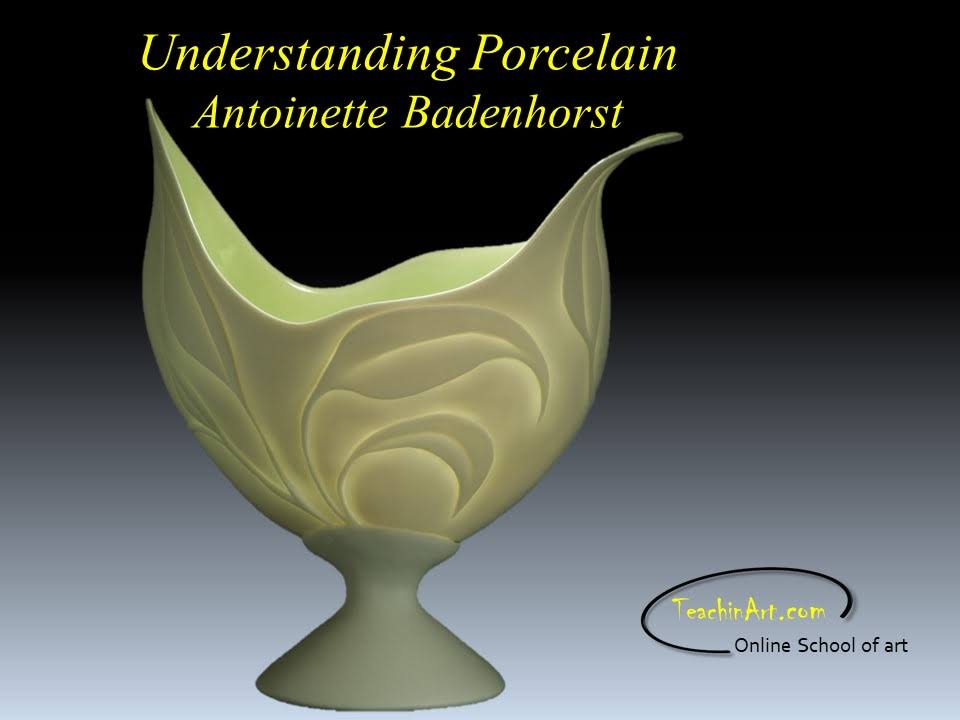
If you understand the character of porcelain clay, you should be able to control the movement, the thickness, and the colors of porcelain art. It is worked and handled like clay, but when fired, it becomes glasslike. Porcelain art is known for its translucency, beauty, and strength. For centuries, it has been used as fine dinnerware in kitchens, but has proven to be strong and solid in outside constructions and even in space. That may be the reason why Antoinette Badenhorst refers to porcelain as the "Diva of clay".
Understanding porcelain is an online ceramic class with Antoinette Badenhorst as potter and instructor at TeachinArt online art school.
​
​Understanding Porcelain online class
​
  • $249​
  • 10 weeks of viewing
  • All questions answered via email
Click to register for class
Registration is open.
​10 Weeks will be added to the registration date to get the end date of the class.
Scroll down for preview and contents of the class

Preview Understanding Porcelain online class

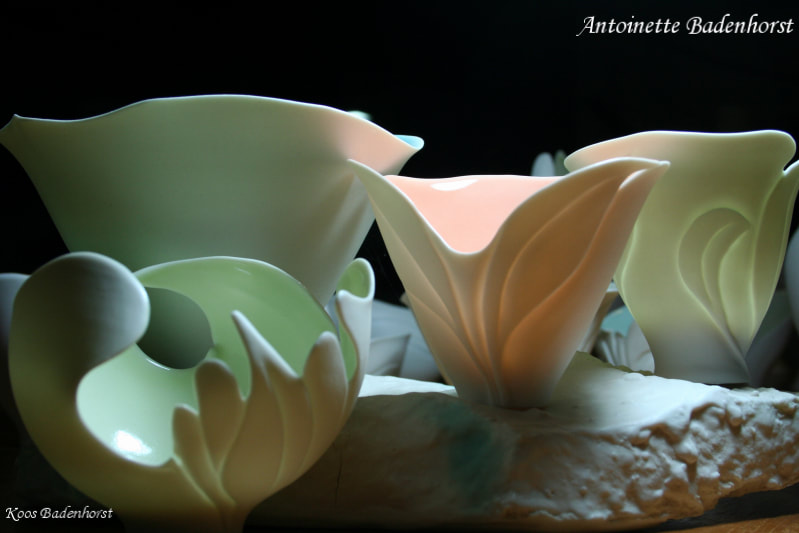
Working with porcelain is not as difficult as many potters think. If you know the character of the clay and understand the particle movements of porcelain, then you could make translucent porcelain bowls and other sculptural vessels. 
​
Break the myths and begin to understand the character of porcelain in these clear, close-up and detailed video demonstrations. With direct online access to Antoinette throughout the course, potters will be assisted to easily work with porcelain clay, while pushing their own limits. Whether hand building, throwing, trimming or altering on the potter’s wheel, beginners to advanced potters will learn to work easily and successfully with the “Diva of clay” and get translucent porcelain.

​Antoinette addresses design, firing and glazing techniques to prevent slumping and cracking and to ensure success with porcelain.

Contents of understanding porcelain

Week 1 - Introduction to pottery clay
This online porcelain class is designed to make a transition from stoneware or earthenware clay to porcelain. There are clear and specific differences in the approach between these clay mediums.
​
  • Introduction to translucent porcelain.
  • Explore the origin of clay and discover the history and character of porcelain clay.
  • What is the difference between stoneware, earthenware and porcelain?
  • How to make fired clay samples?
  • ​Learn how to wedge clay using the bull's head or ram's head technique.
  • ​How to reclaim clay and why it is so cost saving.
​Week 2 - Get to know porcelain clay
Learning to control porcelain starts with pinching. Pinching clay is a great starting point to understand porcelain and to learn how to control the drying stages of the clay. Not all porcelains are the same. Once potters understand the differences in porcelain, they will be able to choose a porcelain for their specific needs and be able to know and understand how to approach it.
  • Best pinching techniques for porcelain clay.
  • Which tools to use for porcelain clay, and how to make your own pottery.
  • How to combine two pinched pots to form a ball of clay with captured air.
  • Trimming pinched porcelain and trimming tools for pinching
  • Controlling the different drying stages of porcelain
  • Learn when and how to use the pinching-in technique
​Week 3 - throwing porcelain on the pottery wheel
During this week of the ceramic online class, Antoinette teaches beginner potters how to throw porcelain on the pottery wheel. She guides and challenges intermediate to advanced potters to push the limits on the wheel to throw very thin and translucent porcelain bowls and cylinders. Designing is an integral part of this week’s class and should prepare ceramic artists for getting back in their own pottery studio. 
​
  • Prepare the clay and the environment for throwing clay on the pottery wheel.
  • Learn how to center clay on the wheel and open the clay walls for a porcelain bowl. Centering clay is important for wheel-throwing.
  • Understand the character of porcelain to control the movement of each clay particle during throwing.
  • Building the walls of the bowl and steady the hand movements to control the shape. 
  • Throwing V-shape and U-shape bowls on the wheel.
  • Learn how the speed of the wheel and the speed of the hand movements influence the throwing process.
​Week 4 - Trimming porcelain
​Trimming with the right tools at the right drying stage may take potters to making transparent porcelain. If you have never trimmed porcelain, this is your chance to learn to do that successfully. Y
ou will learn how to trim smooth and even walls and will learn to prevent slumping and cracking in the rims.  
​
  • Trimming basics for porcelain. 
  • Faults, cracks, remedies & resolutions for pottery clay.
  • When to use sharp tools, and when to use blunter tools for trimming porcelain.
  • Learn how to do right-side-up trimming. Trimming on the inside of a bowl.
  • Trimming upside down
  • Foot rims and other considerations for the bottom of a bowl. 
  • How to re-position a pot on the wheel.
​Week 5
​Porcelain is very susceptible to detail. As the "Diva of Clay" it is necessary to pay attention to those details. During this class, the whole course begins to fall into place and students will see why they should learn how to do things, but also why it is needed to do things in a specific way. This ceramic school teaches potters the how and why reasons.
​
  • Aesthetic considerations for creating elegant and stylish porcelain designs.
  • Porcelain slumping and the 30-degree rule for firing in the kiln.
  • Forms to use for successful firing.
  • ​Beautiful porcelain and attractive decoration.
​Week 6
​Glazing and firing of porcelain are the final actions to ensure success with porcelain. With the right approaches, it becomes easy to obtain beautiful porcelain objects. 
​
  • Glazing that works with porcelain. 
  • Glazing methods for porcelain.
  • Glazing errors that may ruin your porcelain work.
  • Basic electric kiln operation or firing 101 for kilns.
  • Firing schedules and glaze defaults.
  • How to prevent slumping and plucking of porcelain during firing.
  • Packing a pottery kiln.
  • How to support porcelain in the kiln.
  • How to get a smooth and soft feeling on the porcelain after the firing in the kiln.

Registration policy

Who is the target audience for Understanding Porcelain?

  • The  "Understanding Porcelain" e-course is geared towards potters that have experience in basic to advanced clay work. Potters interested to improve their general understanding of porcelain and that is interested in working in porcelain will benefit from this class. It is a wheel throwing, hand building and altering clay class, all in one. We review  basic to advanced techniques and go in depth into the character of porcelain, preparing potters for all our other porcelain classes and help to improve their general skills in clay. 
  • If you never worked with clay before, or completely forgot what you've learned many years ago, this class is unfortunately not for you. We expect that you have a basic understanding of the full pottery making cycle, from the wedging to the final glazed product fired in the kiln and we advice you to get on our distribution list to be informed when we will present a beginners class.
  • Our videos do not have written translations yet and the language used is English.

What do I need for this e-course?
  • You must have access to a pottery wheel, workplace and kiln.
  • You must have consistent access to a computer, iPad or iPhone or related technology.
  • You must have basic computer knowledge. (Although we will assist you with the viewing of the videos, we cannot teach you how to use a computer). 
  • You need basic knowledge of glazes; that is at least glazed some pottery before.
  • When you consider this class you should understand the following terminology: 
  •  Plastic potters clay; leather hard clay; bone dry; green ware; bisque ware; glaze; firing clay; kiln; cone; ceramics;  wheel throwing; pinching; press molding; potters plaster. 

This e-course will help you:
  • if you worked on the wheel before, but experience difficulty with throwing and hand building porcelain
  • if you want to understand and work with porcelain clay
  • if you want to spray glaze
  • if you want to learn how to use mason stains in your glazes
  • if you want to learn how to control forms on the wheel
  • understand the firing techniques associated with porcelain
  • if you want to learn more about porcelain​

What can I expect from the e-course?
  • You will learn how to throw, control and alter some basic forms on the potter's wheel. 
  • You will learn and understand porcelain well enough to use this clay body effectively to push its limits. 
  • When you completed this class, you should be able to throw or hand build porcelain easier and improve your skills with some practice.  Please see the contents list.

REFUND POLICY
  • No refunding.
  • Submitting an online registration indicates your agreement with this policy.
What students say about the porcelain class.
​"I think the class has been very well thought out. The details included in the PDF downloads complete the class. It is just as though I have a textbook to refer back to. l like this class format because it gives me time to experiment, and I get direct, specific, personal answers. I cannot think of any way the class itself can be improved." - Nancy (Washington)
​

"Understanding Porcelain is a detailed explanation and hands on experience constructed to teach students how to think about and work with porcelain. It is excellent and definitely excels in accomplishing its goals. Antoinette communicates her knowledge and respect for porcelain throughout the workshop. I have definitely gained a greater understanding of how to work with and think about porcelain. I highly recommend Antoinette Badenhorst as an instructor and a creator of workshops which help potters of any level." - Marice Pappo (New York)

Links to other pages

Home
Online workshops
Our Instructors
Registered Students
Tips & Demos
Behind the scenes
Student's work
FAQ
Reviews

Workshops by categories

Wheel thrown classes
Handbuilding classes
Teapot classes
Porcelain dinnerware classes
Glazing & decorating classes
Woodworking
©2020 TeachinArt
All rights reserved

About Us
Contact Us
Webmaster: Koos Badenhorst
  • Home
  • Online workshops
    • AAMAL (All Artists Making A Living)
      • Success stories
    • Alternative firing
    • China painting
    • Colored clay
    • Faceted Teapot set
    • Glazing made easy
    • Glazing with Ron Roy
    • Handbuilding porcelain dinnerware
    • Handbuilding Pottery For Beginners
    • Introduction to segmenting
    • Pinching Teapots for Beginners
    • Porcelain handbuilding
    • Porcelain Tips for Wheel Pottery
    • Post-fired finishes
    • Sculpted Clay Creatures
    • Shino glazing
    • Soluble Salts
    • Take throwing to the next level
    • Understanding Porcelain
    • Wheel thrown porcelain dinnerware
    • Wheel thrown teapots
  • Instructors
    • Antoinette Badenhorst
    • Bob Rundquist
    • Connie Christensen
    • Curtis Benzle
    • David Voorhees
    • John Shirley
    • Lynn Barnwell (Guest Artist)
    • Marcia Selsor
    • Marie EvB Gibbons
    • Nan Rothwell
    • Paul Lewing
    • Ron Roy
    • Sam Clark
  • Registered students
  • Contact us
    • About us
  • Tips / demos
  • Blog